Powerlines
/
/
It's in the DNA: How Irish Political Storytelling Conquered the World's Biggest Stage
It's in the DNA: How Irish Political Storytelling Conquered the World's Biggest Stage
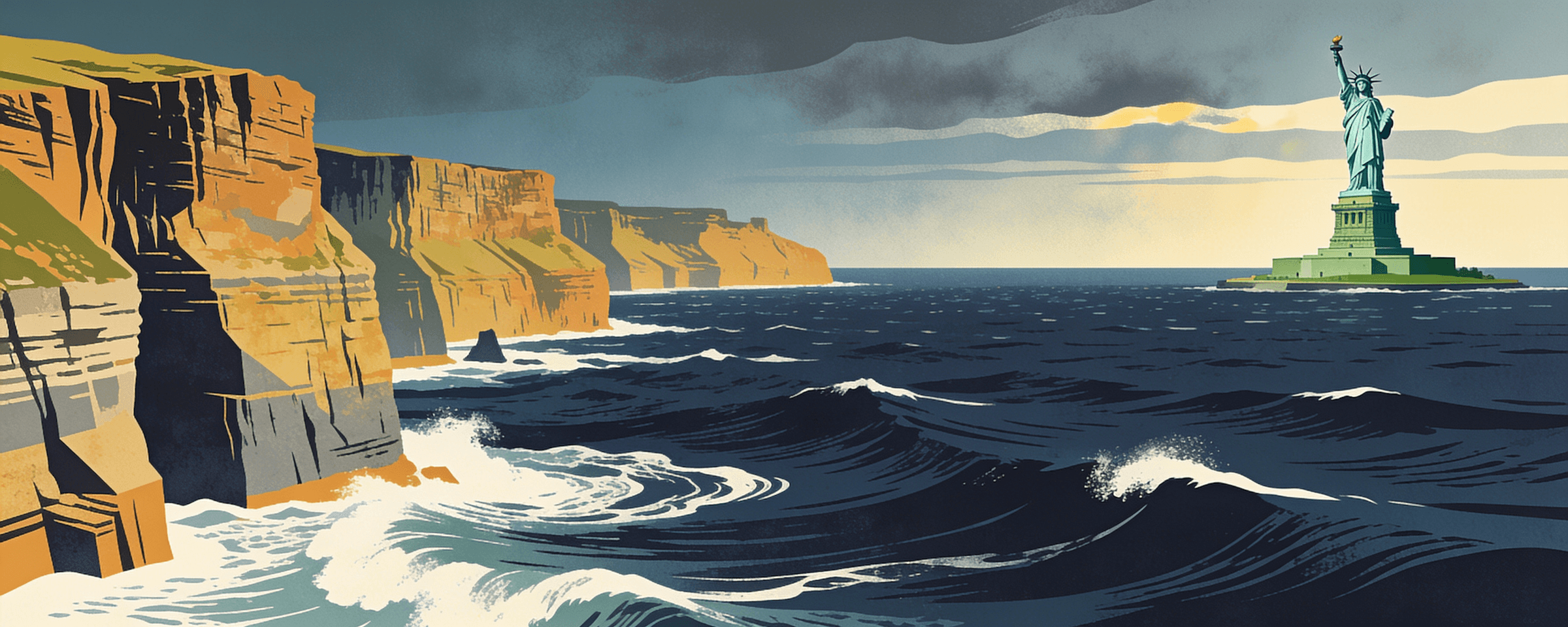
There is a moment in Barack Obama's 2011 visit to Moneygall, County Offaly, that tells you everything you need to know about political communication.
The President of the United States is standing in a small Irish village, population 300, holding a pint of Guinness above his head in front of a roaring crowd. He has just met a distant cousin — traced through genealogical research to a great-great-great-grandfather who left these fields during the Famine. A single Offaly ancestor. And yet the scene is completely, utterly convincing.
"My name is Barack Obama," he told the crowd at College Green in Dublin the following day, "of the Moneygall Obamas."
The crowd lost their minds.
That is not charm. That is craft. And it belongs to a tradition far older than any press office or campaign strategy firm. It is, at its root, an Irish tradition — and it has been shaping the most powerful political communication in the world for the better part of a century.
The Tradition
To understand why Irish-descent politicians communicate the way they do, you have to go back further than Washington. Back to the parish. The GAA pitch. The wake. The crossroads.
Irish political culture was forged in community space, not institutional space. The seanchaí — the storyteller—held a social function, not merely an entertainment one. Stories were how communities made sense of the world, preserved memory, transmitted values, and held power accountable. The Catholic Church's oratory tradition reinforced it: the homily, the accessible parable, the personal detail elevated to universal truth. You didn't argue people toward belief. You told them a story they recognised as their own.
Parish-pump politics — long treated as a pejorative, a small-minded localism — is actually something more sophisticated: the insistence that politics is fundamentally relational. That you represent someone specific, somewhere specific. That your legitimacy is grounded in proximity and accountability, not ideology and abstraction.
When that tradition crossed the Atlantic in the boats of the 19th century, it didn't dissolve. It scaled.
Kennedy: Intimacy at Scale
John F. Kennedy didn't win the 1960 presidential election on policy. He won it on presence.
The first televised presidential debate in American history was decided, in the judgment of most who watched it, by a man who understood that the camera was not a broadcast device — it was a one-to-one conversation with every person watching at home. While Nixon argued, Kennedy connected. The wit was Irish. The self-deprecation was Irish. The ability to make a room of millions feel like a sitting room in Wexford—that was Irish.
His press conferences were performances of warmth and intelligence that left journalists laughing and leaning in simultaneously. He made political communication feel like something you were invited into, not lectured at. That is a very specific register. It has a very specific origin.
Kennedy could trace his family to Dunganstown, County Wexford. He visited in 1963, months before Dallas. The footage of him in that farmyard, surrounded by distant cousins, is one of the most human moments ever captured of a sitting American president. It wasn't managed. It was recognised.
Reagan: The Parable President
Ronald Reagan's Tipperary roots were thinner than Kennedy's, but the communication inheritance ran just as deep.
Reagan was the storyteller-in-chief. Every policy was a parable. Every speech built toward a human moment — the soldier, the immigrant, the small business owner — before the argument was ever made. "Shining city on a hill" works not because it is good policy language but because it is a fireside story. You can see it. You can feel it. You are in it before you have time to evaluate it.
Reagan understood instinctively what the Irish oratorical tradition encodes: you make people feel something first. Then—and only then—you tell them what you believe.
BIDEN: Parish-Pump Politics at Presidential Scale
Joe Biden is the fullest and most sustained expression of the Irish political communication tradition in American history.
Scranton. Amtrak. The rosary beads. The stammer turned into a story of resilience. The grief made public—Beau's death, Neilia's death—offered not as tragedy porn but as credential. I have known loss. I know yours. The entire Biden political identity was constructed around a single Irish premise: I am from somewhere, and I remember where I came from.
His roots ran to County Louth and County Mayo. But more than genealogy, Biden inhabited the tradition completely. The retail politics genius—the ability to make every person in a room feel individually seen—was not a technique. It was a formation. Decades of parish halls and union meetings and kitchen tables. Politics conducted at a human scale, then broadcast.
When critics called it old-fashioned, they missed the point. In an era of increasing abstraction and digital distance, Biden's insistence on the personal was not a weakness. It was, for a long time, his greatest political strength.
Clinton: The Room Reader
Bill Clinton's Fermanagh ancestry is less celebrated than Kennedy's or Biden's, but his communication instincts belong to the same lineage.
Clinton's genius was retail politics elevated to an art form. The ability to walk into any room — a diner in New Hampshire, a union hall in Ohio, a fundraiser in Manhattan — and make every single person present feel that they had been met. Not greeted. Met.
That is not natural charisma, though Clinton had that too. It is a practiced, cultivated attentiveness rooted in the understanding that politics is fundamentally about people, one at a time, and that every individual carries a story worth knowing. The Irish tradition again. The parish made global.
Obama: Proof that it can be learned
Here is where it gets most interesting for anyone in the business of political communication.
Barack Obama is not Irish. He is the son of a Kenyan father and a Kansan mother, raised in Hawaii and Indonesia. His connection to Ireland is a single Offaly ancestor—Michael Kearney, who left during the Famine—discovered by genealogists ahead of his European tour.
And yet Obama's deployment of that connection, and his instinctive command of the Irish communication register, is perhaps the most instructive case study of all.
The Moneygall visit was not cynical. It was joyful. Obama understood what the moment offered — not a photo opportunity but a genuine act of political communion — and he met it completely. The pint. The crowd. The cousin. The speech in Dublin that managed to be simultaneously presidential and personal, global and parochial.
More broadly, Obama's entire political style drew from the well that Irish-American politicians had dug for generations. The personal narrative as credential — Dreams from My Father is a parish-pump memoir on a global stage. The specific detail over the abstract argument. The room before the broadcast. The story before the policy.
What Obama demonstrates, above everything else, is that this tradition is not genetics. It is craft. It can be learned. It can be chosen.
Which is, of course, the most important sentence in this piece.
When the Story Runs Dry
It would be remiss not to note what the Irish tradition is not—and Donald Trump provides the sharpest possible illustration.
Trump has no Irish ancestry. More significantly, he has no Irish communication instinct. His register is the precise opposite of everything described above.
Where the Irish tradition is relational, Trump is transactional. Where it is rooted—I am from somewhere—Trump is rootless, placeless, defined entirely by the present moment and the immediate crowd. Where it builds toward vulnerability, Trump builds toward dominance. Where it offers story, Trump offers spectacle.
There is no parable in Trump's communication. No human moment that opens into something larger. No, I have been where you are. The grief is never made public because grief requires admission of loss, and loss is weakness, and weakness is inadmissible.
This is not, in itself, a moral judgment. As a communications strategy, Trumpism has proven devastatingly effective with specific audiences. But it operates from a completely different emotional architecture—one built on transaction, grievance, and the performance of strength rather than the offering of story.
The romance — for want of a better word — is entirely absent.
And romance, in the political communication sense, matters. It is what makes people feel that a politician is for them rather than merely at them. It is what creates loyalty that survives policy disagreement. It is what generates the kind of trust that can absorb a mistake, a reversal, even a scandal.
The Irish tradition, at its best, manufactures that romance at scale—because it draws on something genuine. A real relationship with place. A real inheritance of story. A real belief that politics is, in the end, about people you can name.
WHAT IT MEANS FOR POLITICAL COMMUNICATORS
Five lessons from the tradition — applicable to any politician, anywhere:
Specificity over abstraction. Name the place. Name the person. Name the moment. Vagueness is the enemy of connection. Irish political storytelling is never vague.
Vulnerability as authority. Grief, struggle, and setback—these are not liabilities to be managed. In the Irish tradition, they are credentials. Proof of humanity. Proof that you have lived in the same world as the people you represent.
The room before the broadcast. The best Irish-tradition communicators never forget that they are, always, talking to someone—not at an audience. The camera is a person. The microphone is a kitchen table. The moment you start performing instead of speaking, you've lost it.
Story before argument. Policy follows narrative. Always. Make people feel the shape of the world you're describing before you ask them to endorse the policies that would build it. Argument closes doors. Story opens them.
Where you're from is not nostalgia — it's legitimacy. Roots are not backward-looking. They are the proof that you are accountable to real people in a real place. In an era when politics increasingly feels abstract and distant, the candidate who can say—genuinely, specifically—I am from here, and I remember it—holds an advantage that no amount of digital advertising can replicate.
If you want a structured framework for building your own political narrative, the Narrative Strategy Kit gives you the tools to start.