Powerlines
/
/
The Conductor: What Emmanuel Macron Understands About Power That Most Politicians Never Learn
The Conductor: What Emmanuel Macron Understands About Power That Most Politicians Never Learn
There is a moment from May 2017 that tells you everything you need to know about Emmanuel Macron.
He has just won the French presidency. The venue for his victory speech is the Louvre — not a party headquarters, not a convention hall, not a television studio. The Louvre. The glass pyramid is flooded with light. The crowd waits. And then, alone, he walks the length of the courtyard to the stage while Beethoven's Ode to Joy — the anthem of the European Union, not of France — swells across the night air.
Every frame of that entrance was calculated. The solitude. The scale. The music. The building — eight centuries of French civilisation at his back. Before he had spoken a single word of his presidency, he had communicated everything: who he was, what he believed, and what kind of leader he intended to be.
That is not instinct. That is architecture.
The Conductor
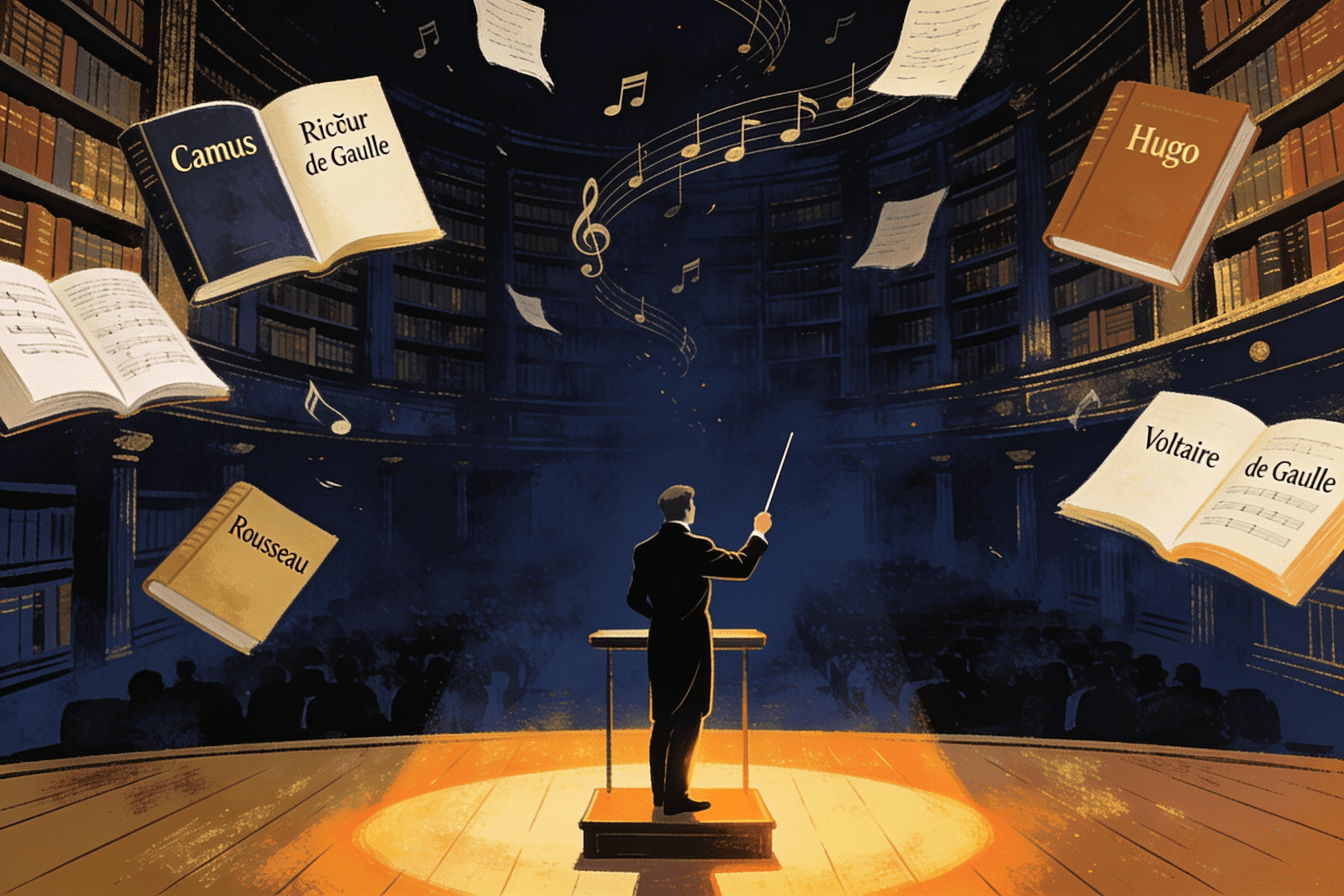
Emmanuel Macron is best understood not as a politician but as a conductor.
He does not need to play every instrument. He does not need to be the loudest voice in the room, the most visible figure on the platform, or the most frequent presence in the news cycle. His power comes from something more disciplined and more rare: knowing precisely when to bring something in, when to hold back, when to let silence do the work that words cannot, and when a single gesture will reorient everything.
In an era of political over-communication — where leaders tweet at midnight, where every reaction demands an instant response, where the news cycle has collapsed into a permanent emergency — Macron's restraint is not a weakness. It is a strategy.
When he speaks, it lands. And it lands because of the silence around it.
This is the first and most transferable lesson of the Macron communications model: scarcity creates value. The leader who speaks only when they have something worth saying trains their audience to listen. The leader who speaks constantly trains their audience to tune out.
Most politicians never learn this. They confuse presence with impact. Macron has always known the difference.
The Stage is the Message
The Irish have always understood that politics is theatre — it is in the DNA, carried across generations in the oral tradition, the parish hall, the convention speech. Macron understands the same fundamental truth, but arrived at it through an entirely different inheritance — through the grand republican stagecraft of the French state, through de Gaulle's studied mastery of symbolic gesture, through a political culture that has always understood that the frame is inseparable from the picture.
Where Irish political theatre is warm, communal, and intimate — the crowd gathered on a hillside, the hand on a shoulder, the story told in a pub — Macron's theatre is architectural, cerebral, and deliberately imposing. But both traditions share the same core insight: how you show up is inseparable from what you stand for.
Study the Macron visual record and a pattern emerges. The bilateral meeting with a resurgent Russian President — a table of extraordinary, almost absurd length, which Macron turned into a visual statement about distance and dignity without saying a word about it. The handshake with a newly elected American president in 2017 — knuckles whitening, neither man releasing first — that became a front page across the world and communicated European resolve more effectively than any speech could have. The address to the United States Congress at Versailles, France's most loaded backdrop, the message about civilisation and alliance embedded in every golden wall behind him.
He chooses his stages the way a playwright chooses a set. The backdrop is never accidental. The entrance is always considered. The image that will travel — because he always knows which image will travel — is composed before the cameras arrive.
This is stagecraft as vocabulary. And it is a skill almost entirely absent from the current generation of political leaders.
The Reading List
Here is what separates Macron from virtually every other working politician on the planet.
He governs from a reading list.
Before entering politics, Macron spent time working as a research assistant to Paul Ricœur — one of the most important French philosophers of the twentieth century, a thinker whose work on narrative, memory, and identity shaped how an entire generation understood the relationship between the individual and the institutions they inhabit. This was not a networking exercise or a line on a CV. It was a formation. It shaped how Macron thinks about time, about story, about the meaning of political action.
When he reaches for Camus in a speech, he is not name-dropping. When he invokes de Gaulle's conception of France as an idea rather than merely a territory, he is not performing erudition. When he frames European sovereignty in the language of civilisational argument rather than policy preference, he is drawing on a genuine intellectual architecture that took decades to build.
This is why his communication sounds different. Because it is different. Most political leaders communicate from briefing notes, from polling data, from the accumulated conventional wisdom of their advisors. Macron communicates from a formed worldview — and the depth shows.
The paradox is that this same intellectual formation contains the seeds of his greatest failures. A man fluent in Ricœur's philosophy of the self can sometimes struggle to speak to a truck driver in Normandy who cannot afford to fill his tank. The very quality that makes Macron extraordinary on the European stage — the long historical view, the civilisational frame, the philosopher's instinct for abstraction — creates distance at the human level.
The conductor who hears the symphony entire sometimes forgets that individual musicians are people, not instruments.
Stepping Into the Vacuum
In recent years, something shifted in the relationship between Europe and its most powerful ally.
The current American administration made its position clear — not through policy alone, but through gesture, tone, and the particular quality of contempt that officials deploy when they have confused aggression for strength. European institutions were dismissed. European security commitments were questioned. Senior figures in the administration lectured European democracies about values while dismantling oversight mechanisms at home. The disdain was expressed not just in words but in posture, in the choice of occasion, in the visible indifference to what the moment required.
Most European leaders responded with the careful, hedged language of diplomacy. They issued statements. They expressed concern. They worked the phones.
Macron responded with clarity.
He named what was happening. He stood at podiums across Europe and made the argument — plainly, repeatedly, with the full weight of his intellectual formation behind it — that European strategic autonomy was not a bureaucratic preference or an act of anti-Americanism, but an existential necessity. That a continent which had rebuilt itself from the ruins of the twentieth century could not subcontract its security, its values, or its future to any external power, regardless of the historical relationship.
In doing so he stepped into a vacuum that no other European leader had the platform, the nerve, or the communications architecture to fill.
This was the Macron model at its peak — restraint deployed strategically, stagecraft in service of substance, intellectual formation producing an argument that rose above the noise of the moment. He did not shout. He did not perform outrage. He conducted.
And Europe, for a moment, had a voice.
The Flaw in the Architecture
No analysis of Macron's communications is honest without confronting the failures.
The gilets jaunes did not emerge from nowhere. They emerged from a specific and sustained communications failure — a president who had spoken so consistently to history and to Europe that he had forgotten to speak to France. The fuel tax that triggered the protests was, in policy terms, modest. What made it explosive was the accumulated sense among millions of French citizens that their president did not see them, did not hear them, and did not speak their language.
The pension reform crisis that followed carried the same signature. The snap election of 2024 — a tactical gamble that handed the initiative to his opponents and shrank his political authority overnight — revealed a strategic overconfidence that the conductor's bearing had concealed for years.
These are not anomalies in the Macron story. They are the structural flaw in the model, present from the beginning and periodically catastrophic in its consequences. The very architecture that produces his greatest strengths — the elevation, the restraint, the long view — disconnects him, at intervals, from the immediate human reality of the people he governs.
The most sophisticated communications model in Europe cannot substitute for the moment when a leader simply sits across from someone, sets aside the philosophy and the stagecraft, and listens.
Even the greatest conductor must occasionally remember that the orchestra is made of people.
What Political Communicators Can Learn
Five lessons from the Macron model — applicable to any leader, at any level:
1. Restraint is a strategy, not an absence. The decision not to speak is as powerful as the decision to speak. Leaders who communicate only when they have something worth saying train their audiences to listen. Scarcity creates value. Noise destroys it.
2. Design the stage before you enter it. The backdrop, the timing, the visual register — these are not vanity. They are vocabulary. The image that travels is composed before the cameras arrive. Every appearance is an opportunity to communicate without words.
3. Intellectual formation produces depth that briefing notes cannot replicate. Leaders who read widely, think seriously, and develop a genuine worldview communicate with an authority that cannot be faked. Audiences feel the difference between a leader speaking from conviction and a leader speaking from a script.
4. The long view is a communications asset — but only when connected to the immediate. The ability to frame the present moment within a larger historical or civilisational argument is enormously powerful. But it must be anchored in the lived experience of the people you represent, or it becomes alienating rather than inspiring.
5. Know when to step into the vacuum. The most consequential communications moments are often not planned — they are recognised. The leader who has built the platform, the credibility, and the intellectual architecture in advance is ready when the moment arrives. Preparation is what makes spontaneity possible.
The Lesson
Emmanuel Macron is not a perfect political communicator. No such thing exists.
But he is something rarer and more instructive: a leader who has thought seriously about what political communication is, what it is for, and what it demands of the person practicing it. A leader who understands that the stage and the speech are inseparable. That restraint amplifies rather than diminishes. That a formed intellect is a communications tool as powerful as any platform or algorithm.
In an era when political communication has been reduced, in too many hands, to noise — to volume, to reaction, to the performance of strength without the substance of it — the Macron model stands as a reminder that sophistication is not weakness.
The conductor does not shout above the orchestra.
He raises his baton, and the room falls silent.
Powerlines is a political communications studio built for politicians and their teams. If you're not telling your story, someone else will.